
Deconstructing Another Wild James Dean Claim
A social media post about the many men James Dean supposedly took to bed appears to mash together and exaggerate already dubious earlier allegations.

I saw that an excerpt from Darwin Porter’s and Danforth Prince’s 2016 biography James Dean: Tomorrow Never Comes allegedly quoting Maila Nurmi (Vampira) was making the rounds on social media again, and I thought it might be worth looking at how the authors appear to have constructed their semi-fictional passage from genuine parts of other books that they wove together and expanded beyond reason.
Of course, throughout the book, the authors claim that they only reported what their celebrity friends told them exclusively on the promise not to reveal it until they died. Conveniently, it means that the authors are not subject to libel claims because the dead can’t sue for libel. That said, while it is impossible to prove that the authors were intentionally lying, I think it is safe to say that the documentary record makes plain that the story provided cannot be true.
Here is the passage as it appears in Tomorrow Never Comes. The brackets are part of the original text. Vampire is speaking here of Dean:
“He was also going through his amputee period, dating this ugly woman who had only one leg. Jimmy told me that she was the leader of a gang of beatnik thieves who made their living robbing the homes of rich movie stars. That night, Jimmy stripped down to his underwear and rubbed her stump. To judge from the rising bulge in his underwear, that turned him on big time.”
[This unidentified woman, of course, was not Toni Lee, the well-known entertainer. It was another amputee with whom Jimmy became involved.]
In her way, Vampira loved Jimmy, but was aware of his dark side, “which was darker than the black nail polish and black gown I wore to introduce those horror movies,” she said. “I agreed with Elia Kazan, who claimed that Dean ‘was a punk but a helluva talent.’ He also said that ‘Dean liked cars, waitresses—and waiters.’ Sometimes, though, he dated high on the hog.”
“Jimmy even managed to seduce Marlon Brando, Paul Newman, Steve McQueen, and Merv Griffin. Even Howard Hughes found out what his underwear was hiding, but had to pay for it.”
“He often took me out and around as his date,” Vampira said. “One night we showed up at a party in Malibu. Jimmy encountered a former lover, who denounced him in front of everybody, claiming he dated women only for publicity. ‘Nobody in his right mind thinks you’re straight,’ the queen shouted at him.”
The quoted material doesn’t sound much like Nurmi, who left lengthy interviews behind through which we can judge her speaking style. The final few words, which attribute the final quote using a written rather than a spoken attribution style strongly suggest that the text is not the result of a spoken interview. When speaking, most people would say “The queen shouted…” before then quoting rather than placing the attribution at the end, in written style.
If we proceed with the assumption that the story is cobbled together from literary sources—and as you’ll see, Nurmi wasn’t present for some of the events “she” claims to have observed—we can begin to trace the facts that underlie an otherwise unattested account.
The first paragraph, about the “amputee period” derives ultimately from William Bast’s 1956 biography James Dean, where he reports a conversation he had with a one-legged woman later identified as Toni Lee (later known as Toni Lee Scott):
“The first night I met him, he asked me all about it. You know—how I lost it, when it happened, everything. I mean, I would’ve said a guy had guts if he’d asked me to show it to him. But you know what Jimmy wanted? He wanted to touch it.
“We went up to my place, and I let him feel it. Nobody’s ever asked for that. He looked at it, like, he examined it, you know. Then, he touched it and asked me to tell him how it felt. He asked me all kinds of questions about it, and how it made me feel. We must’ve talked for hours, just about my leg. We even laughed about it. Then he left. That’s all; he just got up and left.”
In Bast’s version (later repeated and expanded in his 2006 memoir Surviving James Dean), the story is essentially about Dean showing kindness to a woman whom others shunned due to their discomfort with her disability.
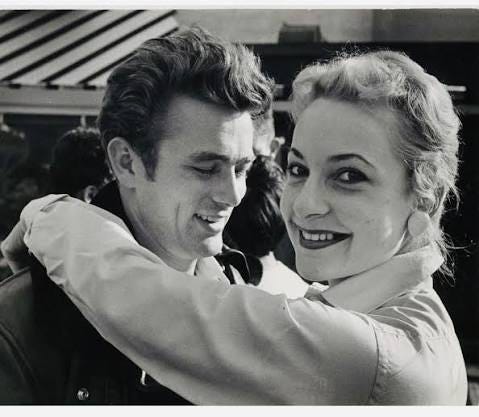
Toni Lee Scott presented a heavily romanticized account of their relationship in her 1970 biography A Kind of Loving, which expands the single encounter reported by Bast into an eighteen-month series of rendezvouses in which Dean repeatedly insisted Scott was beautiful just as she was. Chronologically, this is impossible since she places their first encounter after the release of East of Eden in March 1955, just six months before Dean’s death. She also includes other chronologically incoherent details, such as her claim that Dean came to her distraught after Pier Angeli left him—an event that actually took place in the late summer of 1954. Joe Hyams, a Dean biographer, pieced together his account from memories by sculptor Kenneth Kendall and Nurmi and came to a completely different conclusion, that Scott had known Dean from the summer of 1954 until late November or early December 1954, when they had a falling out. Obviously, all of these accounts cannot be correct. Hyams is almost certainly wrong since Kendall did not meet Dean until January 1955. Biographer Val Holley, who relies on Bast and Scott, places the events between January and September 1955, records no falling-out, and takes no position on whether their relationship was romantic or platonic.
At any rate, Scott’s story led to the widespread rumor—though one that was rarely committed to print outside of the tabloids—that Dean had developed an obsession with mutilation and amputation. Our authors have interpolated a second amputee in Dean’s orbit, one that does not appear in the extant record.
The reference to a thieving band of beatnik thugs appears to reference Dean’s own penchant for consorting with motorcycle gangs.
The next section, referencing Elia Kazan’s statements about Dean, is more or less factually correct. The line about waiters comes from a 1978 biography of Montgomery Clift, where Kazan is quoted (secondhand) as saying in response to Clift’s question about Dean’s sexuality, “They say he likes racing cars and bikes, waitresses—and waiters.” Unfortunately, the author, Patricia Bosworth, did not identify the source. She thanks Kazan in the acknowledgements, so it is possible that he told this to her himself. However, as it comes in a lengthy section on Clift’s interest in Dean for which few sources are identified, it is also possible that it is a secondhand recollection by one of Clift’s friends or relatives.
Kazan did not repeat this statement elsewhere, and both his public and private statements about Dean’s sexuality were contradictory and all over the place, often depending on whom he was speaking with. There is no independent evidence Nurmi was familiar with this line from Bosworth’s biography.
The line about the men Dean allegedly seduced is simply a list of stories Porter and Prince themselves introduced elsewhere in their book through their unevidenced interviews with dead celebrities. Brando was of course the object of Dean’s obsession, but contrary to our authors, there is no evidence they were ever in each other’s presence beyond the brief meetings that occurred during the filming of East of Eden. (I covered Brando in an earlier post: see here.) Dean and Newman were friends and rivals, but again there is no evidence they spent time together, and the rumor emerged mostly from a screen test for East of Eden in which Dean made eyes at Newman to make him uncomfortable. Porter and Prince attribute the allegation to Eartha Kitt, who supposedly confessed to Porter in the 1970s that the three of them (Kitt, Dean, and Newman) had a “celestial” threesome, though Porter did not print it until she died. Kitt, however, always insisted that her relationship with Dean was platonic, and there is no evidence to support the version Porter gives.
Steve McQueen competed with Dean for the same roles, and he actually disliked Dean at first because he believed Dean was taking roles that should rightly have been his. (He changed his mind after Dean was safely dead.) Allegedly, a story has it that McQueen was working at a repair shop when Dean brought his motorcycle in for repairs, and by 1955 were slightly acquainted, but there is no evidence they ever spent any significant time together.
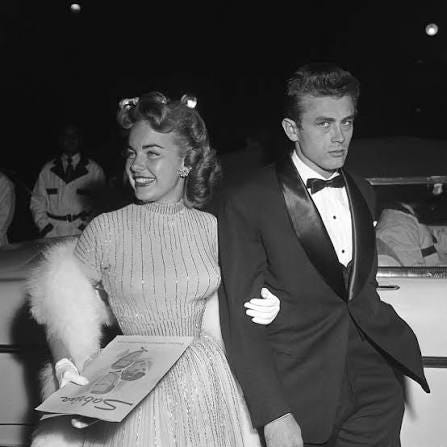
I found no evidence Howard Hughes and James Dean ever met, though Hughes’s then-girlfriend, the actress Terry Moore, did know Dean. They met once, on an arranged publicity date at the premiere of Sabrina in 1954, at a time when Moore was still in a secret relationship with Hughes. The appearance did not go well, and the pair did not get along. Our authors claim Dean and Moore hit it off, shared intimacies, and that she took him to meet Hughes, who paid Dean for sex. Dean’s movements are known for each day in this period, as are Hughes’s, and this claim does not align with the documentary record.
There is even less of a connection between Merv Griffin and James Dean. There is no evidence the two ever met, and the only time Griffin appears to have mentioned Dean is in his autobiography where he relates a story about Dean that Humphrey Bogart told him. The authors allege that Griffin lived next door to Dean at an apartment complex where no record reports Dean as having lived.
The final paragraph is the most egregious. It is a close—but mangled—version of a controversial paragraph in Venable Herndon’s 1974 biography James Dean: A Short Life:
On Thursday night, Jimmy, as he often did before a race, deserted his regular friends and went off by himself. According to a member of a New York S & M club, who was then living in Hollywood, Jimmy went that night to a gay party at Malibu Colony and got involved in a terrible screaming scene. Toward dawn, one of Jimmy’s lovers put him “up against the wall” about his sexual identity and demanded that he “come out” once and for all and stop pretending to be sexually interested in women, except, as his accuser put it scornfully, “for publicity purposes.”
Herndon’s account is quite suspect to start with since its source is simply a rumor attributed to an anonymous man whose story Herndon does not provide any evidence of having verified. Herndon places this event on September 29, 1955—the day before Dean died—and emphasizes that Dean attended alone. Nurmi was not present for this alleged encounter because she and Dean had had a falling out many months earlier. Indeed, it was just that week that Nurmi sent Dean a postcard trying to rekindle their friendship and mailed it to the Villa Capri restaurant, where he often ate, because she did not know is current address. The postcard showed Nurmi as Vampira sitting next to an open grave with the legend, “Wish you were here!” On the day in question, September 29, Dean telephoned Nurmi and asked her if she wished him dead. He hung up on her.
The version Porter and Prince present repositions this event to some unspecified time. The language quoted—the so-called “queen” yelling about Dean not being “straight”—is anachronistic, since “straight” was not used as an adjective meaning “heterosexual” until the 1960s (from the 1940s gay slang “to go straight,” meaning to give up homosexual relations).
While, of course, memory often confuses events and mangles quotes, the combination of anachronisms, unnatural phraseology, and anecdotes so obviously parallel to earlier published sources as to border on plagiarism strongly suggest that none of the words attributed to Nurmi is genuine.